
Monthly Market Update for August 2026: Rising Yields, Strong Earnings, and Trade Uncertainty
August was another example of the idea that strong markets do not require a picture-perfect backdrop. While there continues to be uncertainty around oil prices, the Fed, new tariffs affecting global trade, and interest rates that are at their highest in decades, many positive factors drove broad market indices higher.
For investors, the key takeaway is that short-term concerns are a normal part of markets. Rather than try to navigate each challenge, history shows that portfolios built around long-term goals are the best way to increase the probability of financial success. With this in mind, what drove markets in August, and what should investors keep in mind as they look ahead?
Key Market and Economic Drivers in August
The S&P 500, Nasdaq, and Dow Jones Industrial Average rose 2.6%, 3.9%, and 1.3%, respectively, in August. Year-to-date, they have gained 12.3%, 13.5%, and 10.7%, respectively.
Volatility, as measured by the CBOE VIX index, dropped below the long-term average, ending the month at 16 after climbing as high as 21 the previous month.
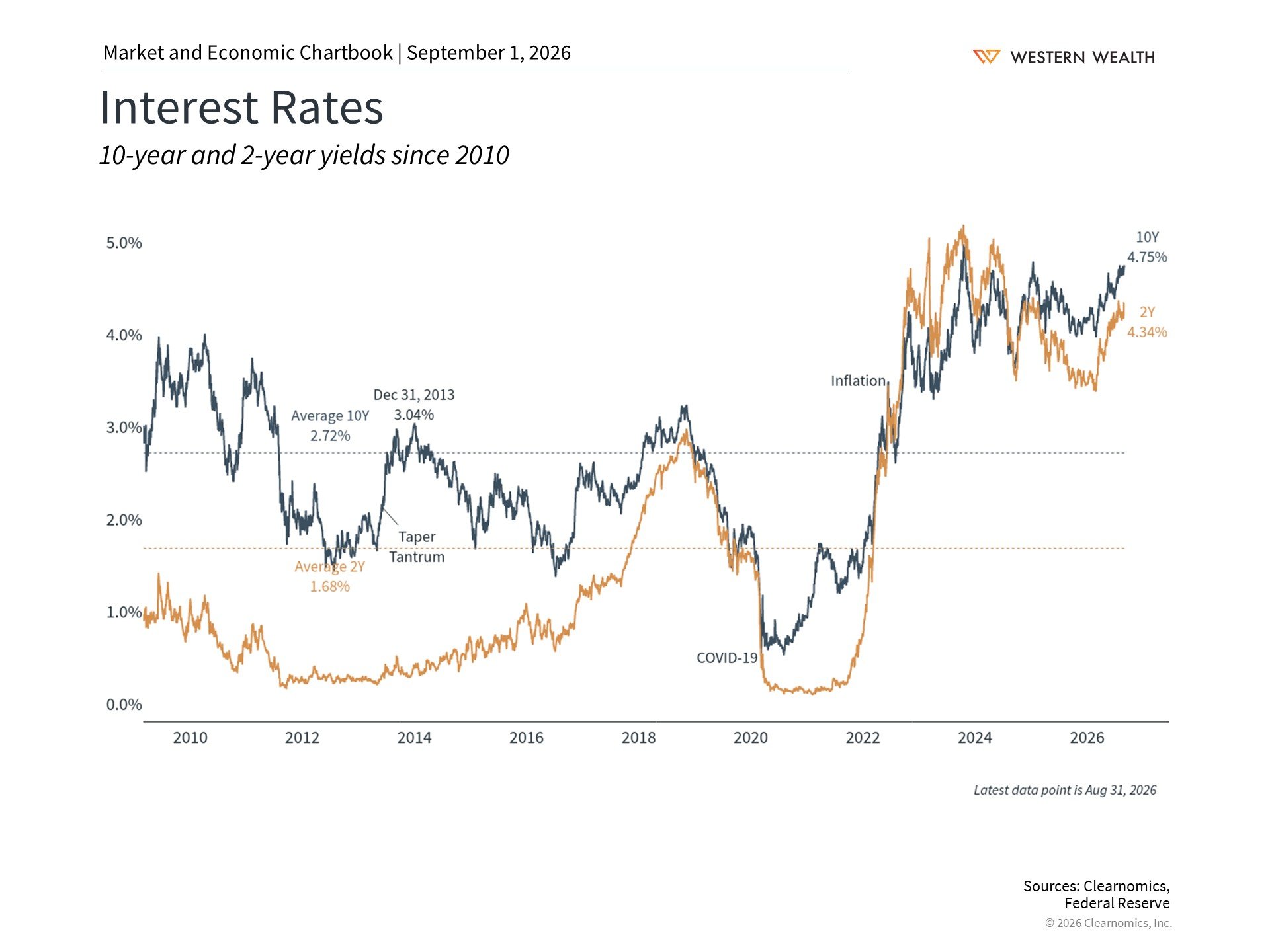
The 30-year Treasury yield reached its highest level since 2007, closing the month at 5.24%. The 10-year Treasury yield ended the month at 4.75%. The Bloomberg U.S. Aggregate Bond Index returned 0.4% for the month.
Oil prices hovered in a range in August after climbing the previous month. Brent crude closed the month at $90.68 per barrel and WTI near $86.27 per barrel.
The U.S. Dollar Index fell to 99.43 at the end of August. Gold ended the month at $4,437.38 per ounce while silver rose to $66.58 per ounce.
The revision to second quarter GDP remained unchanged at an annual rate of 1.5%.
The July jobs report missed expectations with a decline of -23,000 in payrolls compared to a forecasted gain of +80,000. Unemployment fell slightly to 4.1%.
Long-term yields are near multi-decade highs
Interest Rates | Western Wealth
One of the defining features of today's investment environment is that interest rates have remained higher than many expected. The 30-year Treasury yield briefly surpassed 5.3% in August, a level not seen in almost 20 years. Similarly, the 10-year Treasury yield, around 4.8%, is close to its recent peak. (1) This is important because, while interest rates can seem technical, they both affect and are a reflection of the economy.
Typically, higher rates are viewed as being negative for markets, but the key is that interest rates can rise for different reasons. While inflation drove rates higher over the past several years, more recent rate increases have occurred because “real yields” have improved. This is another way to say that inflation-adjusted yields are higher, reflecting the fact that the economy continues to be healthy, especially due to strong corporate earnings. In the long run, this is a positive signal for the overall health of the market, which is why interest rates and the stock market are near their peaks at the same time.
Looking forward, higher rates can also be positive for long-term investors because they create income opportunities across bond holdings. Of course, rising interest rates also weigh on the prices of existing bonds. This has caused major bond indices, such as the Bloomberg U.S. Aggregate Bond Index, to remain flat this year. So, it’s important to interpret rising rates in the context of a well-balanced portfolio and relative to financial goals.
That said, inflation still remains higher than consumers and policymakers would like. The headline Personal Consumption Expenditures Price Index, for example, showed that inflation stood at 3.7% year-over-year in July, while core PCE rose 3.3%, both well above the Fed's 2% target. (2) At the Fed's annual Jackson Hole symposium in late August, Fed Chair Kevin Warsh signaled that a rate hike could arrive sooner. For this reason, markets are now pricing in at least one rate hike this year, and possibly two by early next year. (3)
Corporate earnings are delivering broad-based growth
The Stock Market and Earnings | Western Wealth
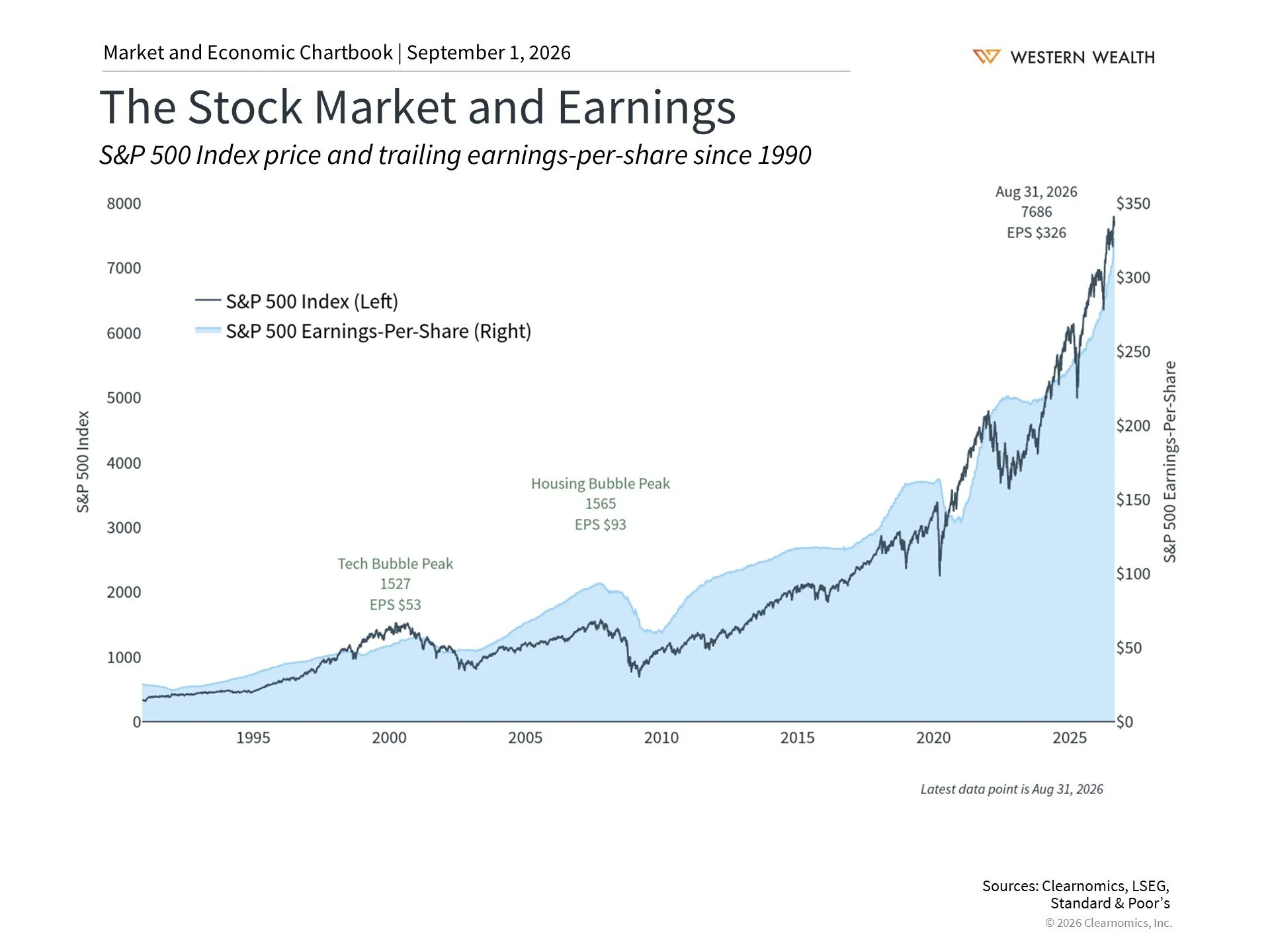
Record highs driven by strong profits: The S&P 500 hit all-time high again in August because corporate earnings were much better than expected, and profits are projected to keep growing rapidly over the next two years.
Widespread economic growth: This success isn't just coming from a few massive companies; almost all business sectors are seeing significant, double-digit profit gains.
The need for a balanced portfolio: Because stock prices remain higher than historical averages, it is important to keep a well-balanced and diversified mix of investments.
Trade tensions are still a source of uncertainty
U.S. Tariff Rates and Trade Wars | Western Wealth
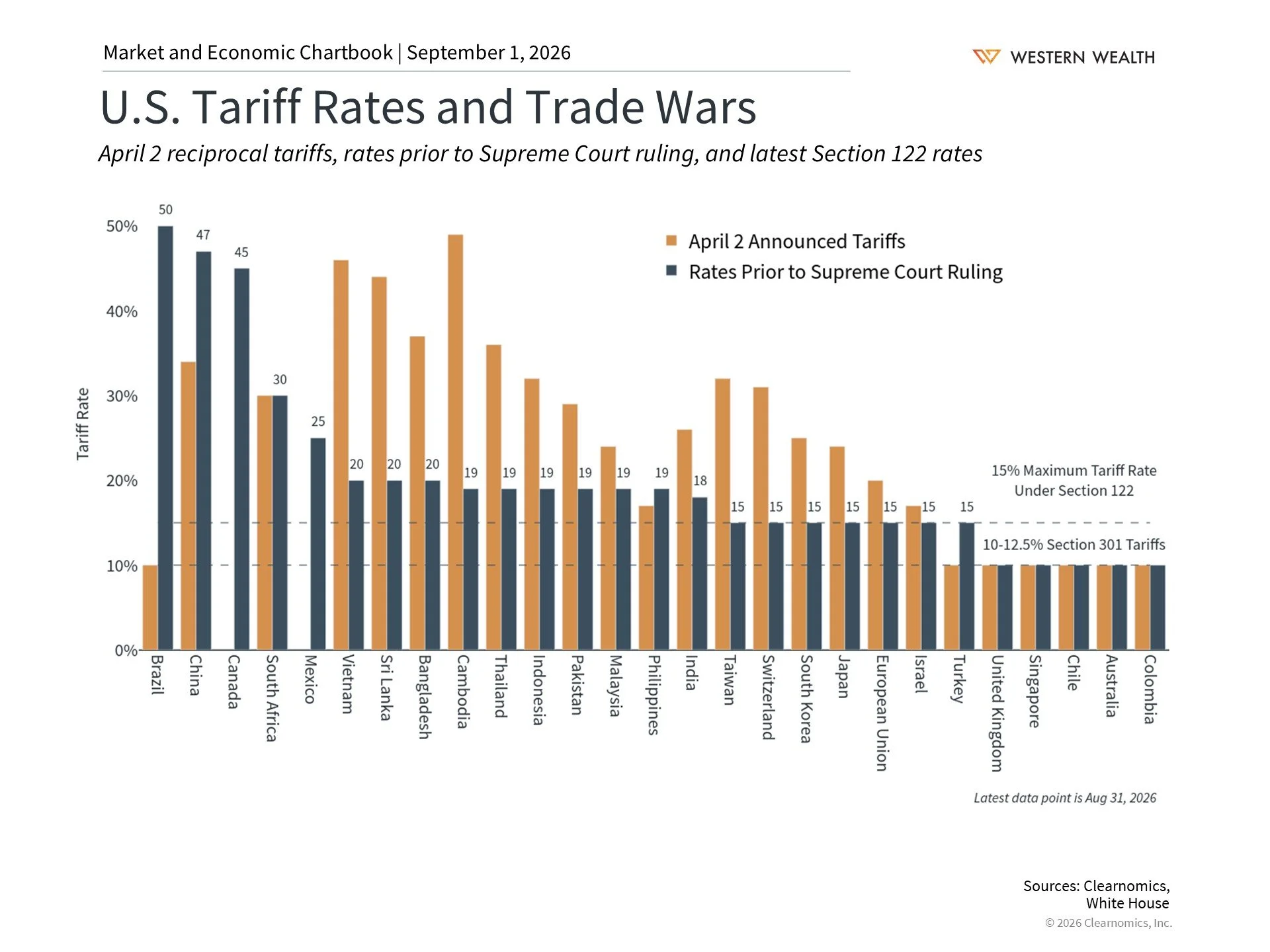
Worst-case scenarios were avoided: Despite the initial fears of investors and economists, the most severe economic outcomes anticipated from the trade disputes have not materialized.
Inflationary impacts were muted: The expected spike in inflation from higher intermediate prices was softened because companies proactively adapted their supply chains, managed costs, and adjusted their pricing strategies.
Massive capital is being refunded to businesses: Following the Supreme Court ruling, the government is returning the original "reciprocal tariffs" to companies, with U.S. Customs and Border Protection already processing $129 billion in refunds.
Trade uncertainty remains high: While the original "Liberation Day" tariffs were struck down and have expired, they were replaced by new tariffs under different laws (like Section 301). This shifting landscape of trade rules will likely remain an ongoing source of uncertainty for global markets in the coming years.
The bottom line? August demonstrated the importance of staying balanced and not overreacting to headlines. Despite periods of volatility, strong corporate earnings and attractive bond yields continue to support long-term portfolios.
If you would like to schedule a review meeting, follow this link: https://calendly.com/jdw_westernwealth
Or reach out to Bertha for scheduling at (720) 970-3757
References
1. https://home.treasury.gov/policy-issues/financing-the-government/interest-rate-statistics
2. https://www.bea.gov/news/2026/personal-income-and-outlays-july-2026
3. https://www.cmegroup.com/markets/interest-rates/cme-fedwatch-tool.html
4. Clearnomics research and LSEG data as of August 31, 2026
5. https://insight.factset.com/sp-500-earnings-season-update-august-7-2026
6. https://www.cbp.gov/trade/programs-administration/trade-remedies/ieepa-duty-refunds